
In the grand cosmic theater of Destiny 2, where Guardians routinely defy the laws of physics and probability, a new challenge was laid down not by a god-like enemy, but by the game's own creators. The 2024 "Into The Light" update, a content bridge to the then-upcoming "The Final Shape," introduced the wave-based defense mode, Onslaught. With it came a developer's offhand remark that would echo through the community like a tantalizing gauntlet thrown: soloing the Legend difficulty of all 50 waves was theorized to be impossible. For a player base known for soloing raids and setting speedrun records, this wasn't a statement of fact; it was a siren song, a challenge wrapped in a dare, dipped in the irresistible glaze of community pride. The stage was set not for a walk in the park, but for a trek through a metaphysical obstacle course where the final boss was the developers' own skepticism.
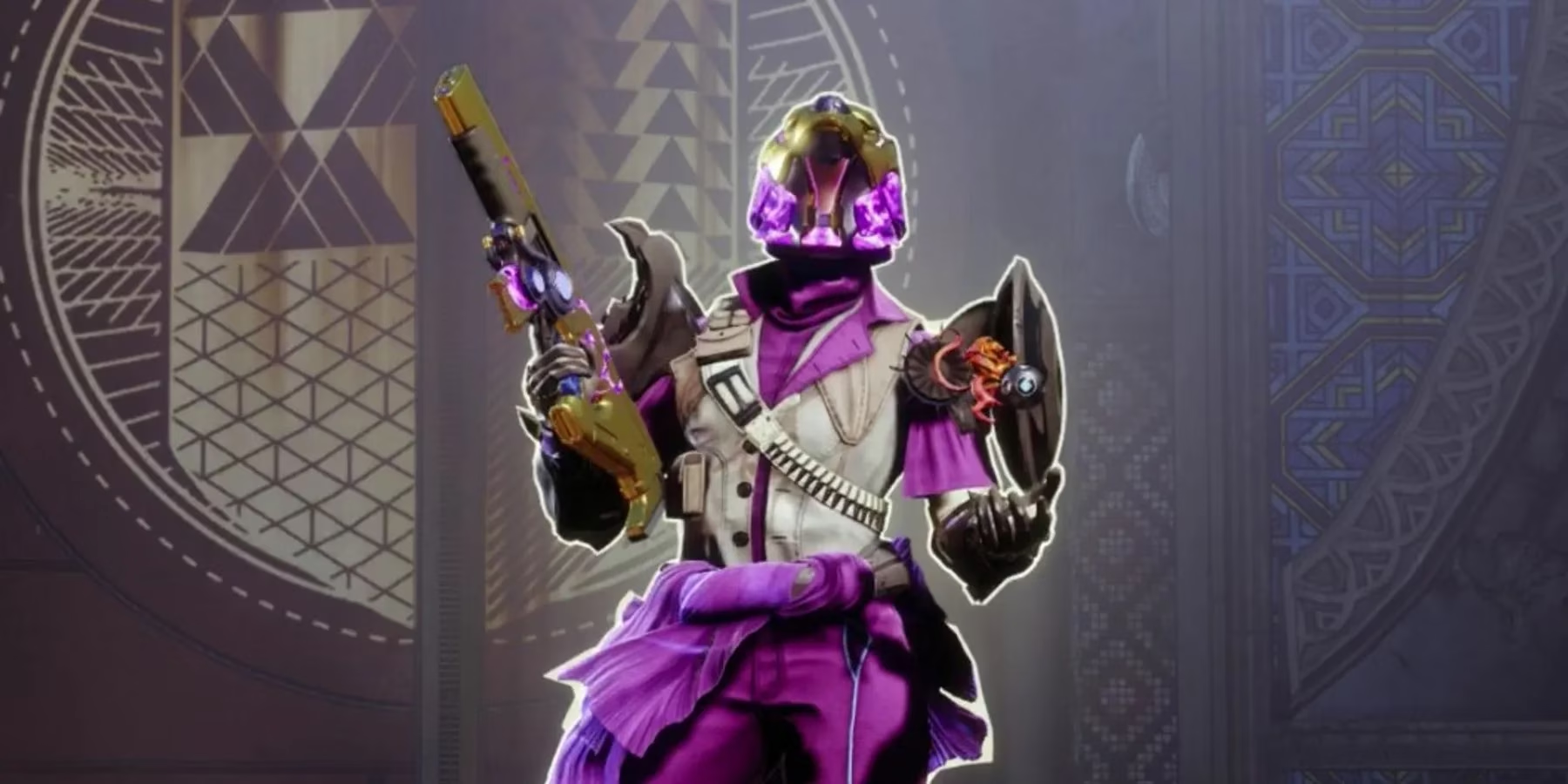
The Gauntlet is Thrown
The legend of the "impossible" task began during the first "Into The Light" Developer Livestream. Senior Social Media Manager Andy Salisbury, around the 42-minute mark, casually theorized that soloing all 50 waves of Legend Onslaught was likely an insurmountable feat. This wasn't just a passing comment; it was a statement that hung in the air like a challenge flag planted on a distant, hostile moon. Other Bungie developers could be heard in the background, a chorus of mixed opinions—some nodding in agreement, others offering cautious dissent. This public pondering transformed the activity from a simple test of skill into a community-wide objective. Bungie had even held an official competition for three-player fireteams to conquer Legend Onslaught first, which only served to highlight the perceived chasm between team play and a solo attempt. The message, intentional or not, was clear: this wall was built not to be scaled, but to be admired from a safe distance with a full fireteam.
The Community's Track Record: A Legacy of Defying Odds
To understand why this "impossible" label was so provocative, one must look at Destiny 2's history. The community has a well-documented reputation for accomplishing the unthinkable:
-
Solo Raid Clears: Players have meticulously deconstructed the most complex, team-oriented raids, turning six-person dances of death into breathtaking solo ballets.
-
Flawless & Speedrun Records: The pursuit of perfection has led to activities being completed not just solo, but without a single death, and at record-breaking speeds.
-
Meta-Defying Loadouts: The community constantly engineers new, powerful weapon and ability combinations, often discovering synergies the developers themselves didn't foresee.
This track record meant the developer's theory landed not as a definitive verdict, but as a delicious contradiction. It was like telling a master locksmith that a particular safe was utterly unpickable, or informing a seasoned chef that a certain recipe was fundamentally inedible. The very declaration was an invitation to prove it wrong.
Anatomy of the "Impossible" Challenge
So, what made Legend Onslaught such a formidable solo prospect? The mode is a relentless, multi-layered assault:
| Challenge Layer | Description | Solo Amplification |
|---|---|---|
| Wave Scaling | Enemy density and difficulty increase dramatically with each wave. | A solo player must handle the same enemy output designed for three, becoming a one-person army against a tide of foes. |
| Objective Defense | Players must protect a central "ADU" structure from being destroyed. | No teammates to cover flanks or revive you if you fall while repairing. The defense becomes a frantic, solitary juggling act. |
| Resource Management | Managing ammo, abilities, and positioning is crucial. | All strategic pressure and resource scarcity falls on a single set of shoulders, with no room for error or downtime. |
| Boss Waves | Periodic, high-health boss enemies spawn, requiring focused damage. | Burst damage phases must be executed perfectly alone, often while adds continue to swarm the objective. It's like trying to perform delicate heart surgery while fending off a swarm of angry hornets with your free hand. |
The mode was a grueling marathon of sustained combat where a single mistake could mean a cascade failure. For a solo player, the early waves might feel like a calm before a storm that never actually calms down, evolving instead into a sustained hurricane of particle effects and combat alerts.
The Triumph of the Solo Guardian
True to the community's spirit, it didn't take years or even months. In a testament to player ingenuity and sheer stubbornness, a Guardian (or likely, several) eventually cracked the code. The "impossible" fell. This achievement was less about brute force and more about a sublime synthesis of:
-
Perfect Loadout Crafting: Utilizing the powerful, reintroduced "meta" weapons from the Into The Light update (like the BRAVE arsenal), combined with exotic armor that maximized survivability and ability uptime.
-
Hyper-Efficient Play: Every movement, every ability cast, every shot had to be optimized. Ammo economy became a sacred doctrine. The successful run was a masterclass in predictive gameplay, anticipating spawns and threats like a chess grandmaster foreseeing moves twenty turns ahead.
-
Unbreakable Patience: Attempts were measured not in minutes, but in hours. Progress was incremental, learning from each failure, adjusting strategies wave by painful wave.
The victory was a community moment. It proved, once again, that in Destiny 2, "impossible" is often just a temporary state awaiting the right combination of skill, creativity, and tenacity. The developer's theory was not a miscalculation, but rather a spark that ignited the community's competitive and exploratory spirit. The solo clear became a legendary feat, a story told in forums and clan chats—a modern-day fable of a player who stared into the game's most daunting challenge and whispered back, "watch this."
The Ever-Evolving Meta and the Spirit of 2026
As we look at Destiny 2 in 2026, the saga of the solo Legend Onslaught stands as a defining chapter. It encapsulates the dynamic relationship between developer and community—a relationship built on respectful one-upmanship. New weapons, balance changes, and subclasses have continued to evolve, but the core lesson remains: never underestimate a Guardian with a goal. Challenges that seem designed as team-only endeavors are, for a dedicated few, merely complex puzzles waiting to be solved. The next "impossible" task is always on the horizon, and the community's response is as predictable as it is thrilling: they'll gear up, log in, and get to work, turning developer theories into player triumphs, one solo run at a time. After all, in a universe where you regularly resurrect from death, what's a little thing like an "impossible" game mode? 💀✨🚀
Comments